
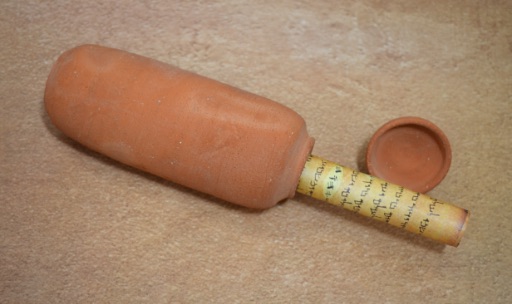
This is a small-scale reproduction of one of the jars that the Dead Sea Scrolls were stored in. The climate was dry and the jars were airtight which helped to preserve the contents.
The scrolls were discovered in 1947 in caves at Wadi Qumran. Before the discovery the oldest manuscripts of the Hebrew Scriptures were from the 9th and 10th centuries AD.
Could these manuscripts be relied on as fathful copies of God's Word? They had been completed well over a thousand years earlier. Professor Julio Barrera, a member of the international team of editors of the Dead Sea Scrolls, stated:
The Isaiah Scroll (from Qumran) provides irrefutable proof that the transmission of the Biblical text through a period of more than one thousand years by the hand of Jewish copyists has been extremely fathful and careful.
Isaiah Scroll 4QS (363/1) contains portions of Isaiah 23:8 - 24:15.
The scroll's original size is approximately 20cm square and dates to the first century AD shortly before the destruction of the temple by the Romans in 70AD. The text in Isaiah 22:10-11 speaks of the great building works conducted by Hezekiah in Jerusalem in the wake of the Assyrian conquest in the 8th century BC. The "outer wall" and a "torn down house" were discovered and are on display in the Jewish Quarter of Jerusalem.